When you book a flight and receive your ticket, you see a message written with small letters in your itinerary that says, CO₂ Emission 235.85 kg/person, informing you of the carbon emission during air travel.
Most people get stunned, and are like, “Wait — am I responsible for that greenhouse gas production?
Why am I being blamed?”
And some get confused over it, wondering what it really means. After all, we’re not flying the plane or burning the fuel.
So why do airlines and environmental reports assign carbon emissions to each passenger?
Let’s break it down in a way that actually makes sense.
Had a recent flying experience?✈️🌍
Sharing your journey can help others make smarter choices.
Take a moment to fill this Google Form and let us know how it went.
Every response helps us improve and keep travelers updated with real stories and tips!
What Are Carbon Emissions in Air Travel?
Whenever a plane flies, it burns jet fuel.
Usually, Jet-A1 kerosene releases carbon dioxide (CO₂) into the atmosphere.
This CO₂, which is a greenhouse gas responsible for trapping heat, contributes to raising the Earth’s temperature, leading to climate change.
The amount of carbon emission per passenger is usually expressed as:
Kilograms of CO₂ (kg CO₂)
This simply means: “If you fly from point A to point B, this is the environmental cost of your seat on that flight.”
How Much CO₂ is it?
Since we see a huge amount of carbon emissions being mentioned per person, how much is actually emitted?
Well, it’s not something you can hold in your hand, but you can imagine it:
- 1 kg of CO₂ = roughly 500 liters of invisible gas
- That’s about 10 full trash bags of greenhouse gas per kg
- So a flight that emits 300 kg CO₂ equals 3,000+ trash bags worth of gas floating into the sky
Why Blame the Passenger?
This is where things get controversial.
Technically, the airline burns the fuel. But when talking about carbon emissions per passenger, nobody is being blamed. They’re just being assigned the impact.
Here’s the breakdown:
- The airplane emits CO₂
- But your choice was to fly, which added to the demand to make the flight happen
- So the carbon emission is calculated as your share of that emission.
It’s like splitting a ride fare with friends. You didn’t drive the taxi, but you helped make the trip happen.
So, the per-person valuation of carbon emissions meant your flight for that distance has led to this much in CO₂ emissions.
So now you’re part of the cost equally.
Understanding With an Example
Let us go deeper to understand it with an example here.
Let us consider a flight heading from Kathmandu to Dubai with a total of 280 passengers on board.
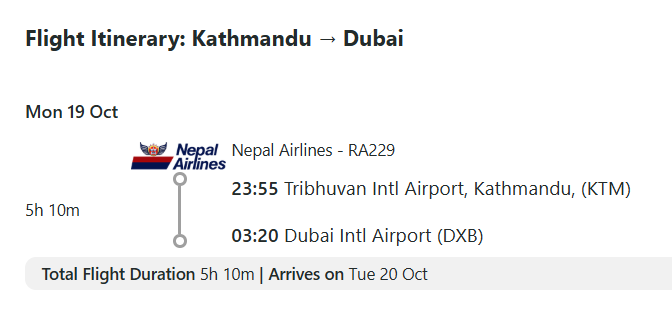
- Distance from KTM to Dubai: 3,000 km (Approx.)
- Average emissions per economy passenger: 0.09 kg CO₂ per km
- Total = 270 kg CO₂ emission per passenger per trip
An aircraft with a seat configuration of 280 seats full with passengers would emit 270 kg CO₂ x 280, which is 75,600 kg of CO₂ for one whole trip.
And if compared the per person carbon emission with others, that’s about:
- Driving a car for 1,000 km
- Using a laptop nonstop for 2 years
- What 13 trees absorb in a full year
Class and Number of Passengers On board Matters Too
The number of passengers flying economy, business, or first class can increase the carbon footprint accordingly.
The seating configuration in an aircraft is such that the space occupied by business class or first class is greater than that of economy class. Hence, bigger spacious seats mean fewer people on board.
So the same plane burns the same fuel, but emissions are divided among fewer passengers.
The number of travelling passengers also matters.
A flight with X number of passengers may have a certain amount of carbon emissions per passenger. However, when the flight has half of its passengers, the assigned carbon emission per passenger is twice as much.
Also, it depends on the type of aircraft operating, whether it is a full-service carrier or a budget airline.
Why It’s Useful to Measure Per-Passenger CO₂
So, by now, let’s be clear that no one is to be blamed, but here’s why we actually measure it per passenger.
It helps us to:
- Make informed choices – Whether it’s better to fly direct flights, economy, or just fewer trips by air if possible.
- Compare travel options – Either take a flight, a train, or a bus, and compare their effectiveness in eco-friendly travel.
- Understand your footprint – Understand how much you have contributed to the growth of it.
- Offset your emissions – What measures can you take to solve it? Either by donating to tree planting, or depending on renewable energy-based vehicles, or any other sources, etc.
Conclusion

Carbon emissions from air travel are real and growing, whether you travel for leisure or travel as a student to your dream destination, But it doesn’t mean that you stop travelling by air.
The aviation industry is evolving and adapting the best measures to decrease the emission rates and update efficient
The goal of assigning carbon emissions per passenger isn’t to make you feel guilty.
It’s to help you understand your share, make conscious decisions, and contribute to a healthier planet.
We’re not to blame for flying.
But we are responsible for choosing how often, how far, and how we travel.
Had a recent flying experience?✈️🌍
Sharing your journey can help others make smarter choices.
Take a moment to fill this Google Form and let us know how it went.
Every response helps us improve and keep travelers updated with real stories and tips!